Overview
This is mostly from the great video Institude of Human Anatomy.
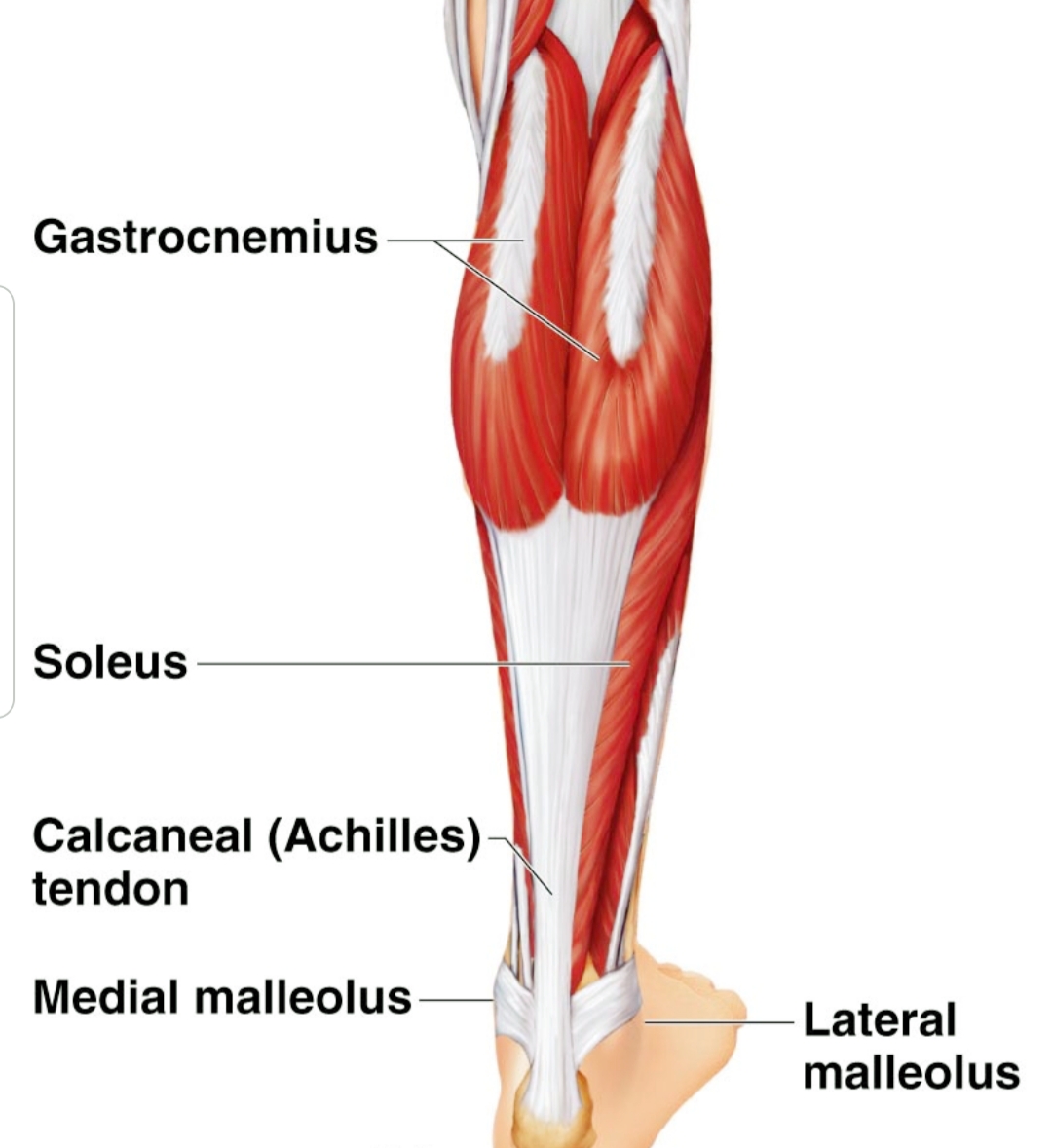
There are 3 main components
- Gastrocnemius -
- it is the superficial muscle
- crosses both the knee and the ankle, which means it is involved in movements in both joints
- it is mostly for powerful and explosive movement, predominatly Type II (fast-twitch) fibers.
- Soleus
- it is a broad, flat muscle, partially covered by Gastrocnemius
- it only crosses the ankle, so it is only involved in the movement in the ankle
- it is more for control and endurance, mostly Type II (slow-twitch) fibers
- Achilles tendon
Exercises
Due to the difference related to different joint movements, exercises such as toe raise can have different mutations
- To focus on Gastrocnemius, keep the knee straight.
- To focus on Soleus, keep the knee bent, or seated. In this way, gastrocnemius will be less involved.
For those with Achilles tendon issue, avoid stretching it in exercises. For example, in toe raise, avoid dipping the heel. We can break it down into two parts:
- In the first part, the heel is above the toe level, where the muscles are being exercised more.
- In the second part, where the heel is below the toe level (to avoid), the muscles are being stretched and may have limited flexibility. In this case, significant stretching force may be applied to the tendon.
What does it all mean for runners
First, adopt more strength and flexibility training for both Gastrocnemius and Soleus. If you want to improve speed, add some emphasis on the Gastrocnemius. But don’t forget that Soleus is the power house for endurance runners.
Focus on eccentric contraction in exercises for better control.
For runners, most injury in Achilles tendon is from overuse, which again point the focus on Soleus since it consists mostly of Type II fibers. Also, consider increasing cushion in the shoes, and improving running forms.